White-Ringed Atlas Moth
Epiphora mythimnia
Saturniidae · Lepidoptera
What Is It?
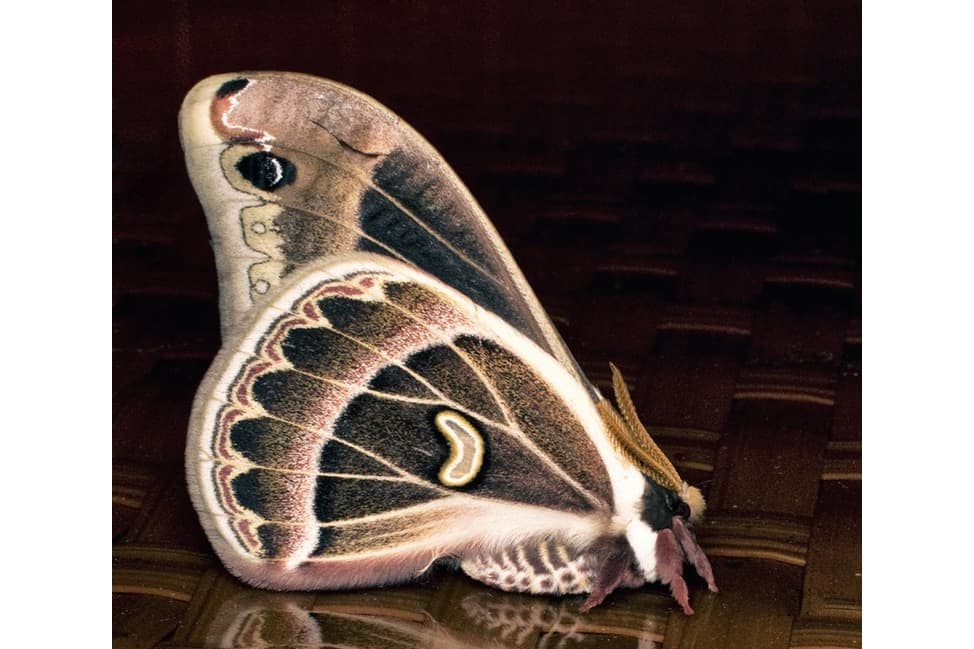
The white-ringed atlas moth is an African emperor moth in the silkmoth family Saturniidae — not a true Attacus atlas moth, which lives only in Asia. Its scientific name, Epiphora mythimnia, was coined in 1849, before the genus Epiphora itself even existed; the moth that later gave that genus its name turned out to be this exact species under a different label. Its closest genetic relatives, oddly, live in Asia and North America rather than Africa, hinting the whole African lineage may descend from a single ancient long-distance crossing.
What Does It Look Like?
Despite 175 years of scientific attention, no rigorous published measurement of its wingspan or wing pattern could be found. What is documented is a family trait: an eyespot near the wingtip detailed enough to mimic a vertebrate eye, likely giving a hungry bird pause — probably the source of the 'ringed' in its name, though no source confirms that link directly. The moth's broad, feathery, comb-like antennae (as opposed to a female's slimmer, thread-like ones) mark it out as male, tuned to detect a female's scent from miles away.
How Does It Live?
Its basic biology — egg counts, moult stages, time in the cocoon, generations per year — has never been rigorously documented, a striking gap for a species named in 1849. What is confirmed is its diet: caterpillars feed mainly on jujube-type trees in the buckthorn genus Ziziphus, with occasional use of croton trees and one flowering-tree genus, Fernandoa — three of the confirmed feeding records specifically from East Africa.
Where Does It Live, and What Does It Eat?
Global occurrence records place this moth in ten African countries, with South Africa holding the majority of sightings and Kenya running second at 27 confirmed records — spanning Nairobi's highland gardens, Nyeri, the coastal lowlands around Kilifi and Taita Taveta, and semi-arid country near Kibwezi and Kasigau. Its wider genus, Epiphora, holds around 20 species, all found only in Africa.
Why Does It Matter?
A recent Kenyan survey of edible emperor-and-silk moths across 15 farming zones turned up seven species people eat or could harvest commercially — this one wasn't among them. No conservation status has been confirmed either way, so its ecological or economic weight remains, for now, an open question rather than a settled answer.
A Scientific Plot Twist
This species was named in 1849 under a description borrowed from an unrelated moth family, then formally rehomed in 1860 into a brand-new genus built around a specimen that turned out to be the very same species under another name — while its true genetic relatives turned up on two continents it has never lived on.
What's the Kenya Connection?
Kenya is a genuine, well-documented part of this moth's range, with records running from Nairobi's high-altitude gardens to the hot coastal bush near Kilifi and out into the dry country near Kibwezi — mostly drawn from decades of private and museum lepidopterist collections, plus more recent citizen sightings around Nairobi.