Red Velvet Mites
Trombidiidae · Trombidiformes
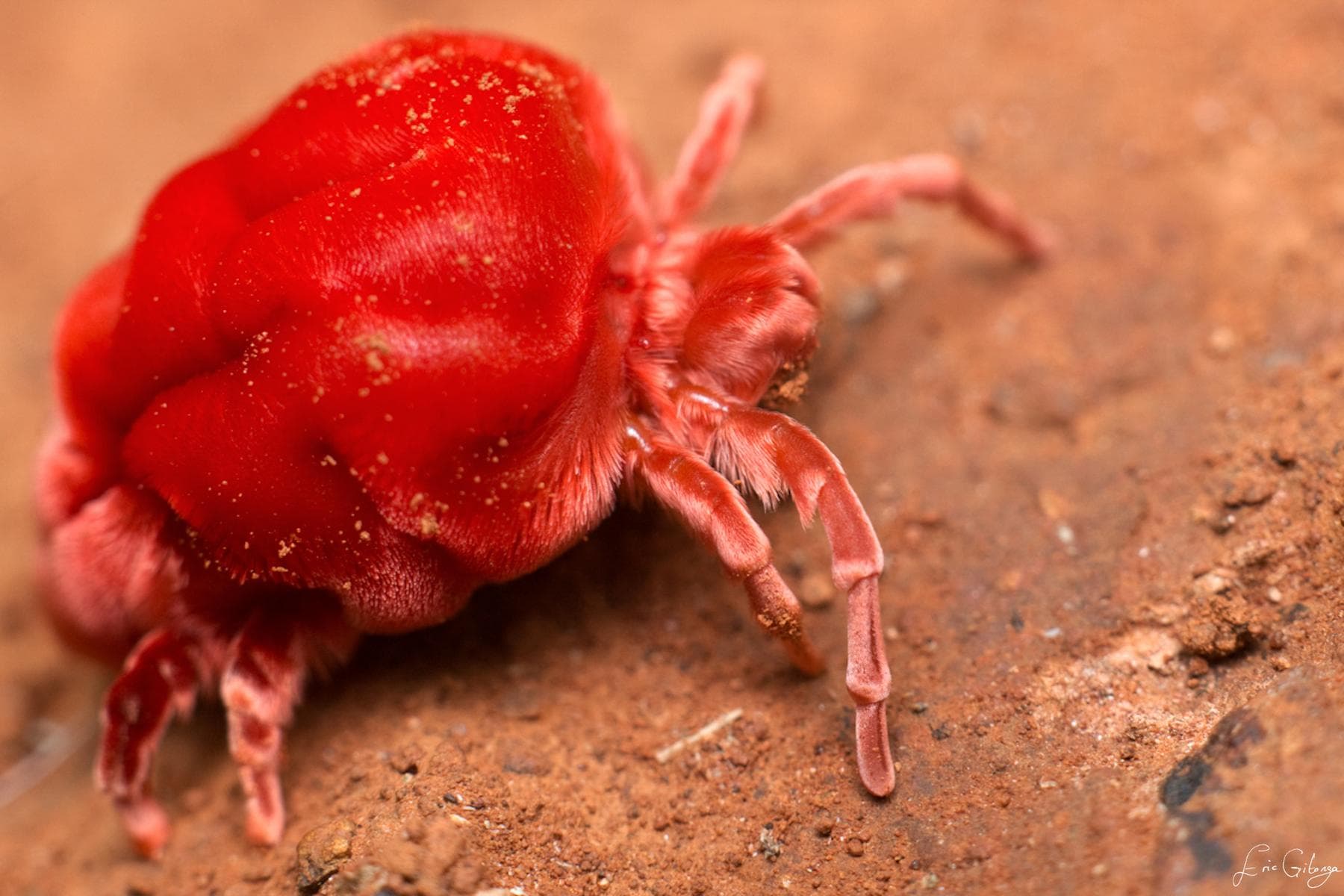
What Are They?
Red velvet mites are fuzzy, red, ball-shaped relatives of spiders and ticks; the giant species found across Kenya's drylands, often referred to as Dinothrombium, are the largest mites on Earth. They spend nearly their whole lives underground and erupt en masse once or twice a year, a phenomenon photographed across Kenya from Samburu and Wajir to Amboseli and the coast at Watamu over more than twenty years.
What Do They Look Like?
Adults reach up to about 1.4 centimetres long, the largest in their family, and are covered in dense red 'fur,' sometimes with white spots, over a tough, hard-to-puncture shell. Babies look nothing like adults — hatching with six legs as hitchhikers on other insects, while adults have eight legs and roam freely.
How Do They Live?
An adult may spend 51 weeks a year underground and essentially dormant, then emerge in huge numbers within hours of the first heavy rain, timed to coincide with the mass flights of termites and ants, which the adults prey on for one to three days before returning underground. As larvae, red velvet mites are instead parasites, hitching rides on grasshoppers, beetles, moths, spiders, and sun spiders, and a single female can lay up to 100,000 eggs.
Why Are They Red?
Their vivid red colour is a warning signal, and testing against 40 predator species found almost none would eat one twice. Their reportedly bitter, astringent, spicy taste and tough shell mean researchers describe them as having essentially no real predators, and injecting their body fluid into lab mice caused no poisoning, suggesting the defence is external rather than an internal toxin.
Why Do They Matter?
Red velvet mites are not pests; by feeding heavily on termites and ants right as those insects emerge in flight, they likely act as a seasonal check on those populations. Claims that people in parts of Africa eat giant red velvet mites as a seasonal treat come only from informal, non-scientific sources gathered during this research, so this is noted as an intriguing rumour rather than a confirmed fact.
What's the Kenya Connection?
Red velvet mite emergences are a distinctly Kenyan phenomenon, with sightings recorded across Baringo, Samburu, Laikipia, Kajiado, Meru, Wajir, and Kitui, typically following the first rains. One record comes from a wildlife biodiversity survey run jointly by a conservancy trust and a research institute in the Masol and Pellow conservancies.