Picasso Bug
Sphaerocoris annulus
Scutelleridae · Hemiptera
What Is It?
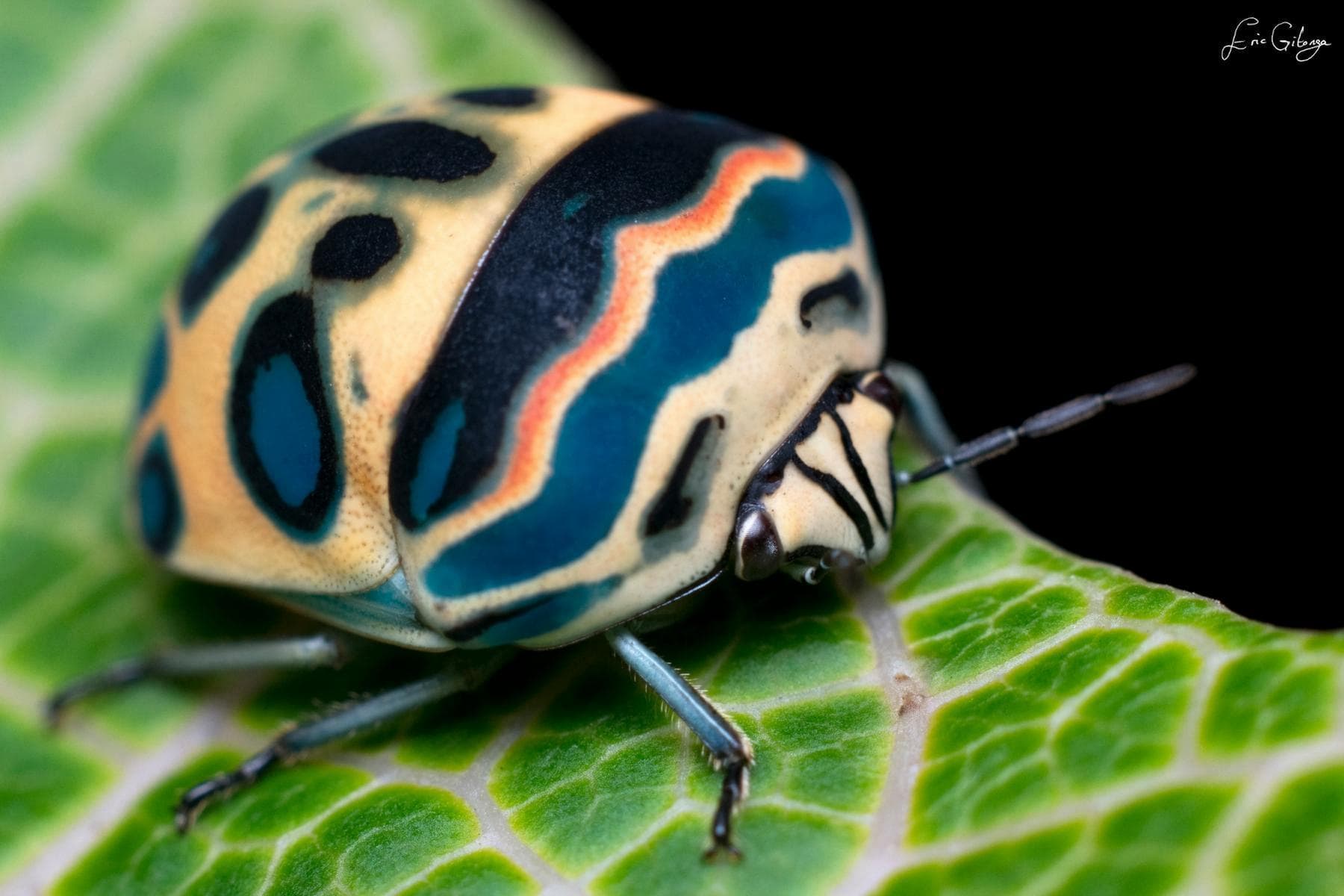
The Picasso bug is a true bug, a close cousin of stink bugs, wearing an oversized dome-shaped shell (a scutellum) that covers its entire back like a hard-shell suitcase, patterned in swirling bands of turquoise, black, cream, and orange with no two patterns quite alike. It's found across Sub-Saharan Africa, and Kenya is its best-documented home — roughly a third of all confirmed sightings anywhere in the world come from Kenya alone, more than double any other single country.
What Does It Look Like?
A rounded, strongly domed, shield-like body resembling a tiny ornate turtle shell, with bold swirling colour bands earning the 'Picasso' nickname. The oversized back-shield (scutellum) covers the whole abdomen and both pairs of wings underneath, a feature that gives this family its 'jewel bug' name. No rigorous scientific description of exactly how big this species gets, or how males and females differ, could be found in the authoritative sources checked.
How Does It Live?
The detailed life story of this species — egg count, nymph stages, breeding season — isn't nailed down anywhere in citable, checkable research; much of what's repeated online traces back to unverified, crowd-edited sources rather than real research. A close relative in the same family is known to practice genuine maternal care, guarding her egg mass and newly hatched young (removing her causes near-total nymphal death within days) — whether Picasso bugs do the same hasn't been confirmed, but it's a trait that shows up across the family.
Where Does It Live, and What Does It Eat?
In Kenya, it's known to feed on avocado flowers, piercing them to drink the plant's sap — a bad infestation can be intense enough to slow the tree's growth, which matters to Kenya's large avocado farming industry. Popular sources claim it feeds on cotton, coffee, and citrus too, but none of that could be confirmed against real scientific or government sources, so it's left out here rather than repeated as fact.
Why Does It Matter?
Where it shows up on farms it's treated as a minor pest, mainly of avocado flowers in Kenya. But it's worth remembering a species can be scientifically fascinating without being economically dramatic — this one's real claim to fame is its stunning good looks and its surprisingly murky taxonomic history.
A Scientific Plot Twist
For a long time, insects like this were assumed to belong to a particular subgroup of jewel bugs, but a detailed 2018 genetic study sequencing DNA across the whole jewel bug family found the Picasso bug's true relatives are different from what was long assumed, placing it in a different branch of the family tree. The formal global scientific name also carries no subspecies, while Kenyan agricultural records refer to it with an extra name tacked on — a small mismatch between museum taxonomy and on-the-ground naming.
What's the Kenya Connection?
Kenya isn't just somewhere this species happens to occur — it's the single best-documented country for it anywhere on Earth based on confirmed observation records, and it's also tracked there as a known avocado pest by Kenya's own agricultural research organisation. Most people who spot its dazzling shell on a leaf have no idea it's practically a local celebrity.