Paper Wasp — An Insect That Builds Its Nursery Out of Chewed Wood
Hymenoptera
What Are They?
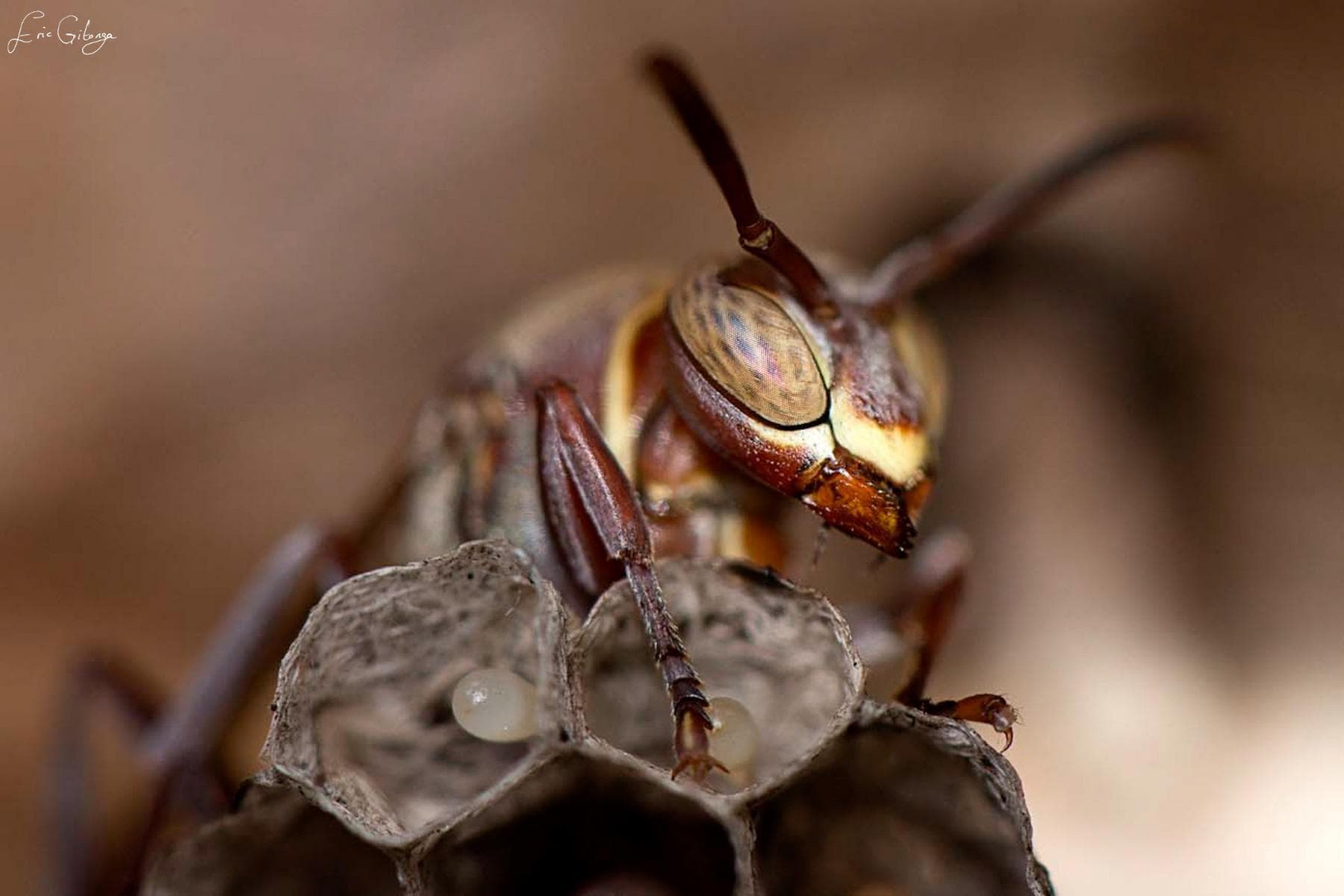
Here's the fact that gives this wasp its name: it makes its own paper. It scrapes fibers off dead wood and plant stems, chews them up with saliva into a pulpy mush, and spreads that mush out to dry into a tough, papery comb — the same basic trick humans use to make paper. The wasp in this photograph is standing guard over exactly that kind of nest, its exposed honeycomb-like cells visible with pale eggs tucked inside several of them. "Paper wasp" is really an umbrella term for a whole group of related wasps (scientists call the group Polistinae) rather than one single species. In Kenya and the rest of East Africa, the two big players in this group are Polistes and a genus called Ropalidia — and Ropalidia turns out to be the far more common and diverse one here, with dozens of African species, many only recently sorted out by scientists.
What Do They Look Like?
Paper wasps have a slender, almost elegant build compared to the stocky hornets and yellowjackets you might picture — longer legs, a narrower waist, and wings that fold lengthwise along the body at rest, like a knife closing into its handle. Many species are reddish-brown or amber-colored, sometimes with pale yellow bands, and one Kenyan species, Polistes fastidiosus, grows to a solid 13–17 millimeters, noticeably bigger than some of its close relatives. One quirk that trips up even scientists: a paper wasp queen doesn't look any different from her workers. There's no special "royal" body plan. Whether a wasp ends up laying eggs or spends her life foraging and building comes down to social politics inside the colony, not anything visible on her body.
How Do They Build That Nest?
Watch a paper wasp at a dead branch or a weathered fence post and you'll often see her scraping away with her mandibles, gathering tiny bundles of wood fiber. Back at the nest, she mixes that fiber with saliva and presses it into shape, cell by cell, building a comb that's left completely open to the air — no protective outer shell, unlike the fully enclosed paper "balloons" hornets build. Some species even fine-tune the recipe: adding more saliva after rain to waterproof the walls, or in one clever species, laying down almost pure saliva to make walls so thin and clear they're practically see-through. Starting a colony is a gamble one queen doesn't always take alone. Sometimes a single founding queen builds and defends everything herself. Other times, several females team up to start one nest together — and when that happens, they don't cooperate right away. They squabble first, even eating each other's eggs, until one wasp wins out and becomes the egg-laying queen while the others settle into worker roles.
Do They Really Recognize Each Other's Faces?
This is the single strangest fact to come out of paper-wasp research: one species, Polistes fuscatus, can recognize individual nestmates by their faces — something otherwise unheard of in the insect world. Each wasp's face carries its own unique pattern of markings, almost like a fingerprint, and other wasps in the colony learn to tell those patterns apart the same holistic way humans recognize faces, rather than just checking for isolated details. Even more interesting: this skill isn't universal across the species. Wasp populations that tend to set up nests in cooperative groups have wildly varied, easy-to-tell-apart faces, while populations that mostly nest alone have plain, near-identical faces. In other words, the more a wasp's life depends on keeping track of who's who among her nestmates, the more individual her face becomes.
Who Takes Over When the Queen Is Gone?
In a related genus, Ropalidia, scientists found something almost eerily orderly: remove the queen from a colony, and the workers don't erupt into a free-for-all fight to replace her. Instead, one particular worker quietly steps up and becomes the new queen, with barely any resistance from her sisters. Oddly, the wasp who's next in line usually isn't the toughest or most dominant one — she's simply the oldest. It's less a power struggle than an orderly queue, something rarely seen this cleanly in the animal kingdom.
What Do They Eat, and Who Eats Them?
Adult paper wasps mostly sip nectar for their own energy, but their larvae need protein — so the adults go hunting for caterpillars, chew them into a paste, and feed that to the grubs waiting in the comb. That makes paper wasps genuinely useful garden allies: in controlled trials, related American paper wasp species cleared out caterpillar pests from cabbage-family crops within hours of finding them, which is why some researchers now suggest recruiting these wasps as a natural pest-control tool instead of reaching for a spray can. The wasps have their own enemies too. In some regions, a moth caterpillar has evolved to sneak into paper-wasp nests and impersonate a wasp larva closely enough to avoid being noticed, quietly eating the real wasp grubs from the inside. Fungal diseases have also been found creeping through invasive paper-wasp colonies abroad, hinting that even a well-armed, stinging insect has plenty working against it.
Where Are They Found?
Paper wasps as a group are found almost everywhere except Antarctica, but Ropalidia — the genus most common in Kenya — is spread across Africa, South and Southeast Asia, and Australia. Confirmed Kenyan residents include Polistes fastidiosus, found widely across sub-Saharan Africa, and several Ropalidia species, including ones scientists have only formally named in the last couple of years — some even carrying Kenyan place names, a sign of just how much fieldwork in Kenya has shaped what we know about this group. That last point matters more than it might sound: when researchers took a close genetic look at African Ropalidia wasps in 2025, they discovered that one single "species" everyone thought they knew actually turned out to be at least 25 genetically distinct lineages hiding under one name. Kenya's paper wasps, in other words, are still being discovered.
Why Do They Matter?
Beyond quietly patrolling gardens and crops for caterpillars, paper wasps are stinging insects with real medical weight — their venom is one of the more common causes of serious allergic reactions to insect stings in parts of the world where they're studied. That's a double-edged fact worth knowing if you live alongside them: respect the nest, but also remember the wasp hovering near your vegetable patch is very likely working in your favor, not against you.
A Few Things Worth Knowing
Nobody has yet nailed down a distinct Kenyan or Swahili name for paper wasps specifically — "nyigu" simply covers wasps in general — which is itself a small reminder of how much local, ground-level knowledge about even common insects is still unwritten. Ropalidia has a split personality unmatched by any related genus: some of its species found new nests the solitary way, one queen at a time, while others send out entire swarms of workers to establish a new colony together — two totally different strategies for starting a family, both used within a single genus.
In Summary
A paper wasp's whole life is built around one simple, remarkable trick: chewing wood into paper and turning it into a nursery, cell by cell. From there, its story only gets stranger — a queen indistinguishable from her workers, orderly successions instead of coups, and at least one species that can literally recognize its family by face. Whatever nest you spot tucked under an eave or a leaf here in Kenya, there's a good chance you're looking at one of the least appreciated, most quietly industrious insects working in the garden around you.