Orchard Orbweaver
Tetragnathidae · Araneae
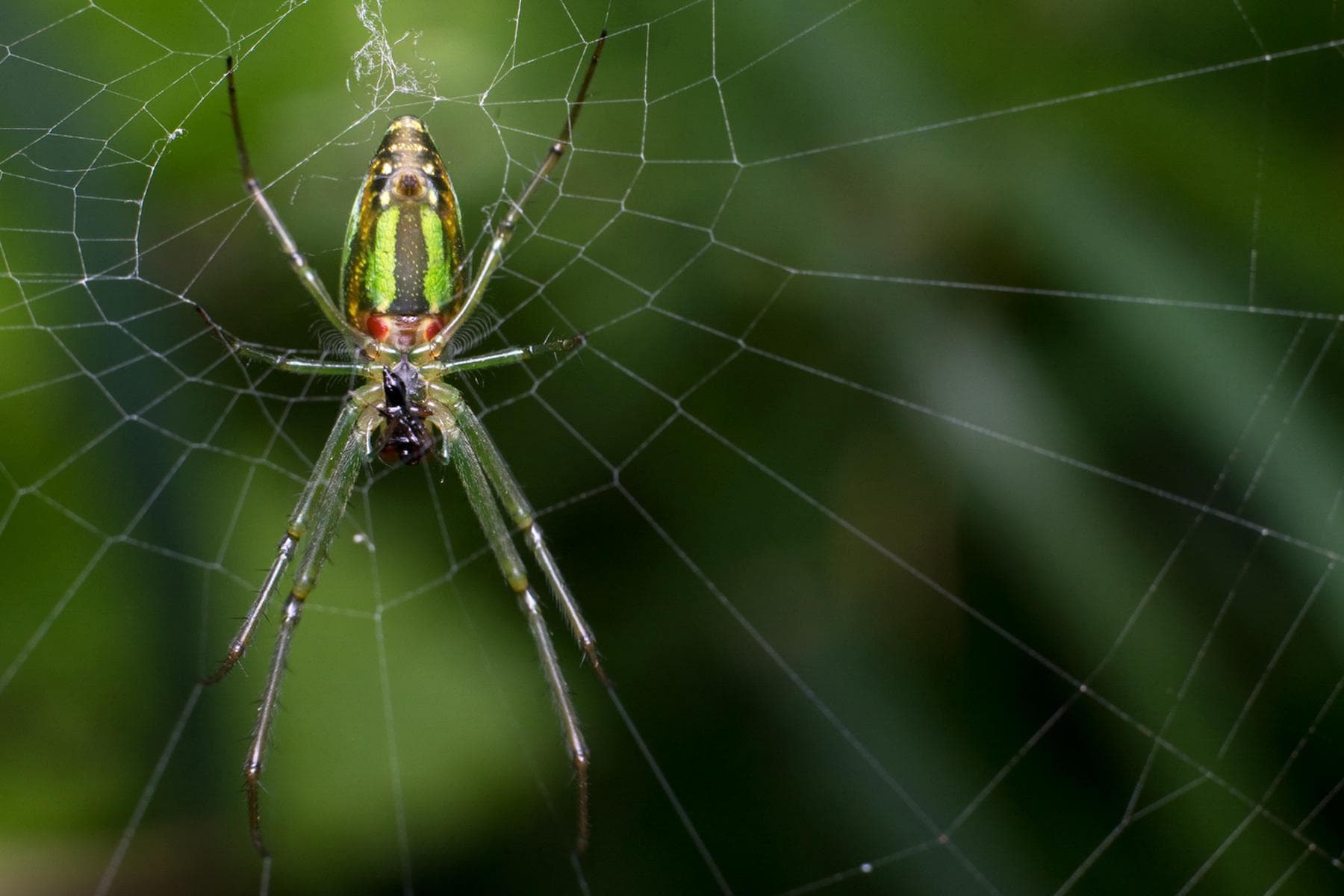
What Is It, Really?
The spider belongs to the genus Leucauge, nicknamed 'orchard orbweavers,' 'stretch spiders,' or 'long-jawed orb weavers,' with more than 160 species across the tropics and subtropics and at least nine species in Kenya. The exact species in a given photo cannot be confirmed since Leucauge species are usually told apart by microscopic genital structures; the best guess based on coloring is often Leucauge festiva, though this remains an educated guess rather than a certainty.
What Do They Look Like?
The body is oval and elongated with a silvery-white abdomen (from microscopic guanine crystals in the skin), dark stripes, and a splash of reddish-orange near the front, with pale, thin, disproportionately long legs. It rests with its front two leg pairs stretched forward and its back pair stretched behind in a dramatic 'X' pose that, combined with its shape, camouflages it as a twig or blade of grass.
How Do They Live?
Leucauge spiders molt while hanging from the center of their own web, often leaving the discarded shell tangled in the silk afterward. Courtship involves the male tapping, jerking, rocking, and twanging the web's silk in a specific sequence; a receptive female responds by opening and closing her fangs and tilting upward. Certain parasitic wasps sting a Leucauge spider and somehow induce it to build a simplified web to hold a wasp cocoon before killing it.
Where Do They Live — and Are They in Kenya?
Yes, confidently: a major survey backed by the National Museums of Kenya and international partners documented over 800 spider species in Kenya, nine of them Leucauge. Leucauge festiva specifically is recorded from Nairobi and Moyale and across a wide swath of Africa from Ethiopia and Sudan to South Africa and Madagascar. Checking citizen-recorded iNaturalist sightings, scientists found some Kenyan Leucauge identifications didn't make biological sense — likely misidentifications.
Should You Worry About a Bite?
No — long-jawed orbweavers like Leucauge have jaws built for grabbing prey, though their venom is not considered dangerous to people. Of the spiders that do pose a medical risk to humans (widow and recluse spiders), Leucauge isn't among them.
Friend of the Farmer — Sort Of
Leucauge eats mosquitoes and other small flies caught in its web, generally acting as a farm ally. However, in Japanese greenhouse eggplant farms, a relative, Leucauge blanda, was found eating a beneficial predatory bug farmers had released to control whiteflies and aphids, since the spider can't distinguish 'good' from 'bad' prey caught in its web.
The Real Marvel: Weaving Together
An individual Leucauge web is modest — roughly dinner-plate sized up to about a metre — built from strong 'dragline' silk for the frame and stretchier, gluey silk for the spiral, with some spiders rebuilding up to 90% of the web daily. Some Leucauge species build colonially, with individual webs stitched onto one shared silk scaffold over streams, larger spiders claiming the top spots; others build their webs into the framework of a much bigger Nephila (golden silk orb-weaver) web to save silk.