Jewel Beetles
Coleoptera
What Are They?
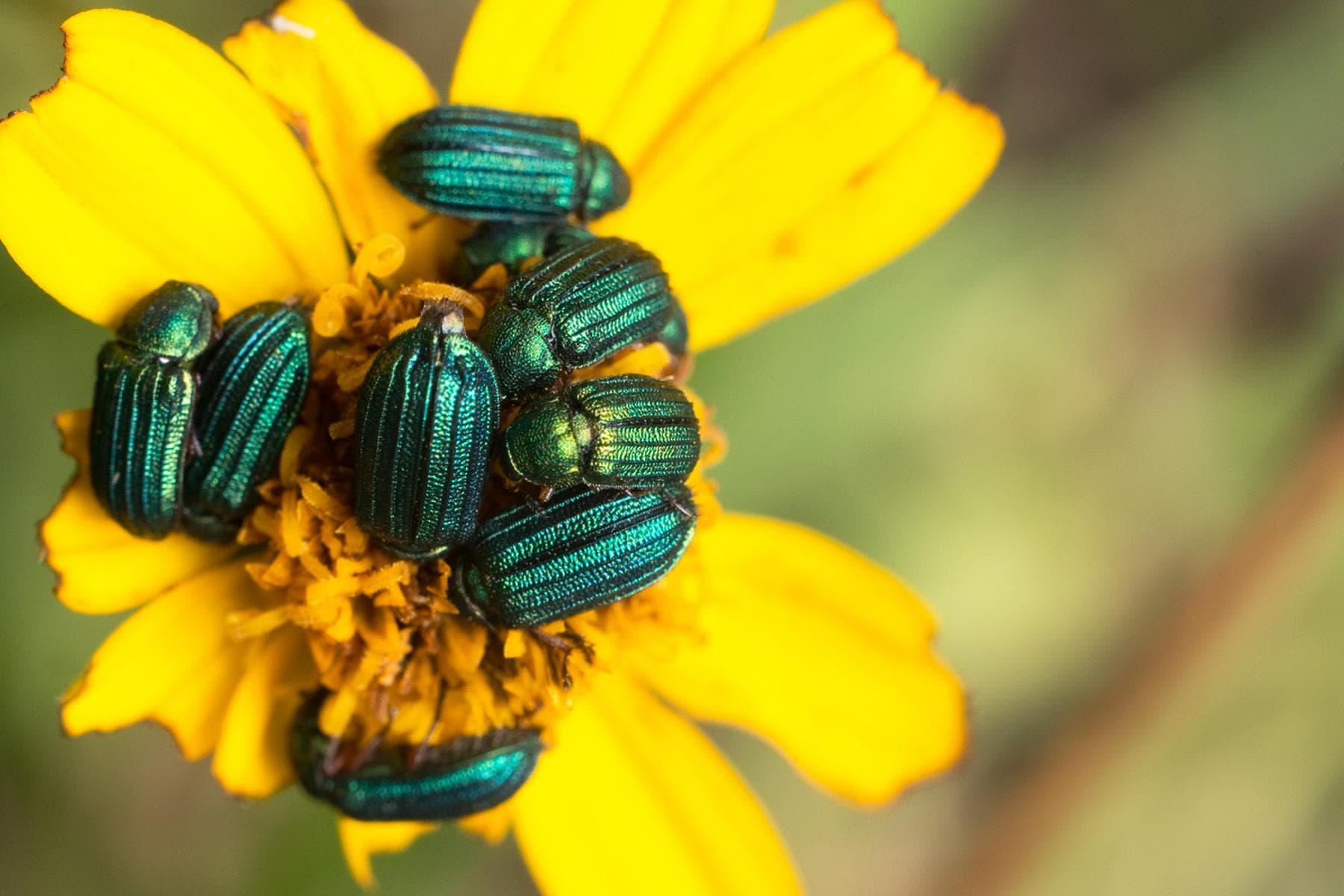
These are jewel beetles — a family of over 15,000 species worldwide, famous for wearing what looks like polished metal instead of ordinary insect armour. The beetles in this photo, clustered together feeding on a yellow daisy-like flower, most likely belong to a genus called Meliboeus, which is known to visit flowers for pollen and has confirmed populations in Kenya — though pinning down the exact species from a photo alone isn't possible, so think of this as a strong, evidence-backed guess rather than a certainty.
What Do They Look Like?
Adult jewel beetles have a hard, teardrop-shaped body, flattened top to bottom, with short antennae and ridged or grooved wing covers. But the real showstopper is the colour. That shimmering green-blue isn't paint or pigment at all — it's built from dozens of microscopically thin layers in the beetle's outer shell, stacked so precisely that they bend and reflect light the way a soap bubble or an oil slick does. Scientists studying a close relative found around 16 alternating layers producing the green shimmer, packed into a shell just over a thousandth of a millimetre thick. At certain angles the reflected light even becomes polarised — a property invisible to us but possibly used by the beetles themselves to spot a still, silent mate sitting nearby.
How Do They Live?
A jewel beetle's life starts as an egg tucked into bark or a plant wound. The larva that hatches is a strange-looking grub with a flattened, oversized "head" segment — entomologists nickname them "flatheaded borers" for exactly that reason — and it tunnels through wood or plant stems as it feeds and grows. Depending on the species, that tunnelling phase can be astonishingly long: one African jewel beetle, Sternocera orissa, is documented taking up to 35 years to finish developing as a larva before finally emerging as a short-lived, flying adult. Adults of many species, though, spend their days doing something much gentler than boring through wood — visiting flowers to feed on pollen and nectar, exactly as this cluster is doing.
Where Do They Live?
Jewel beetles turn up across Kenya, from the dry northern counties of Wajir and Marsabit to the highlands around Nairobi and Naivasha, and down into the hot savanna near Kajiado and Taita Taveta. Museum and citizen-science records place several genera — Sternocera, Lampetis, Julodis, and the pollen-loving Meliboeus candidate identified here — right across these very different Kenyan landscapes, from arid scrubland to moist forest edge.
Why Do They Matter?
Beyond their ecological role — some feeding on wood, others visiting flowers — jewel beetles carry real cultural weight in East Africa. Their glittering wing covers are strung into ceremonial necklaces: Maasai and Samburu women wear necklaces made from Sternocera hildebrandti elytra alternated with seeds for special occasions, and the Kamba people of Kenya make similar ornaments. Beyond Africa, jewel beetle wings were once stitched by the thousand onto Victorian gowns as a shimmering, biodegradable alternative to sequins — a fashion trend that started in royal courts in India and spread through the British Empire. Some species are also eaten; one southern African jewel beetle is prized enough as food that a small handful can supply half a day's zinc requirement, and is reported to taste something like eland meat when roasted in hot ash.
Anything Surprising?
One relative of these beetles, the aptly-named "fire beetle," can detect a forest fire from over 100 kilometres away using heat-sensing organs on its body — among the most sensitive infrared detectors known in the animal kingdom. It seeks out fires deliberately, because its larvae can only survive in wood that has just been burned. It's a reminder that the same family producing beetles glamorous enough for royal fashion also produced one of nature's most extreme heat-sensing instruments.