Froghopper
Hemiptera
What Are They?
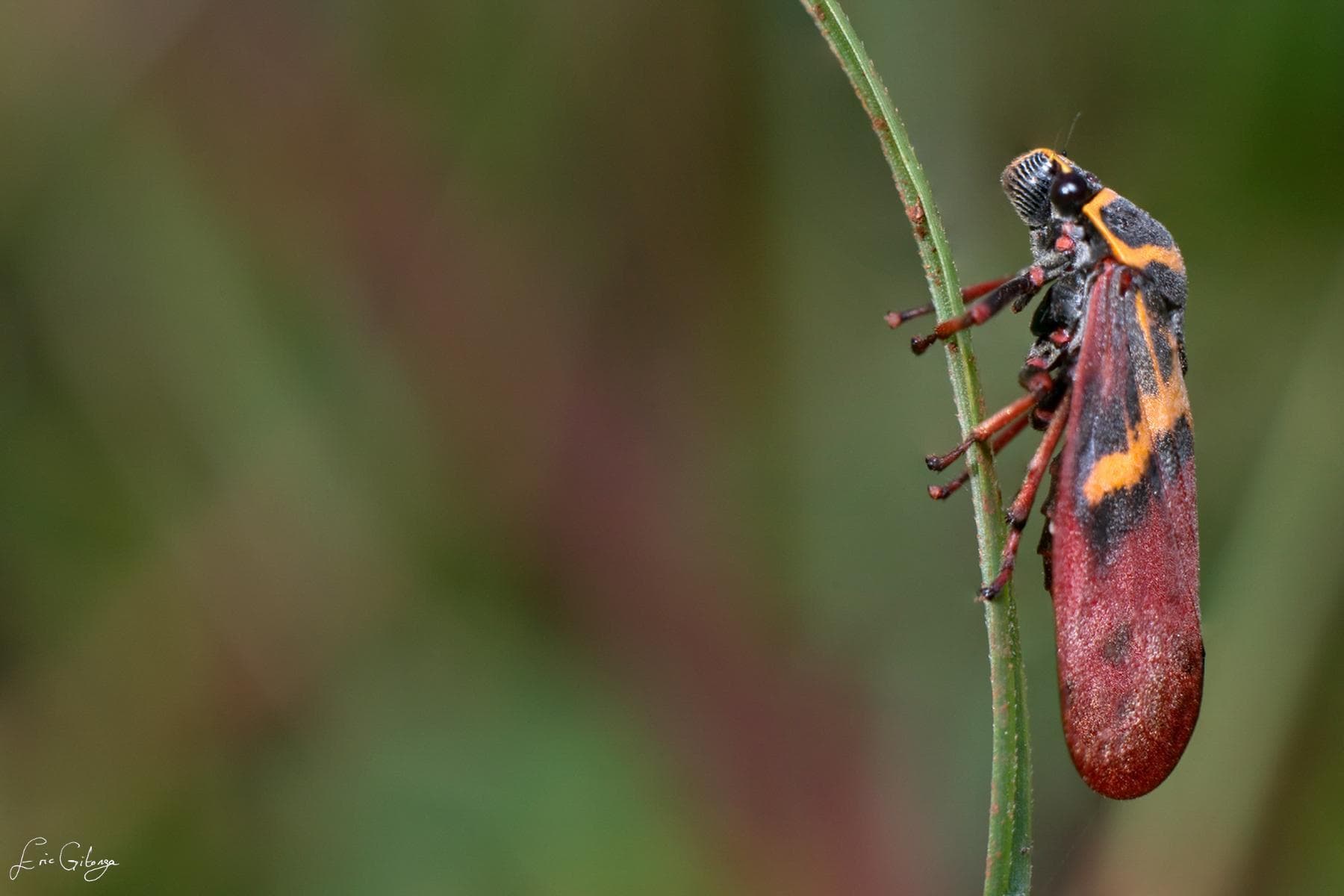
Froghoppers get their name from an unmistakable party trick: they can leap enormous distances relative to their own size, launching themselves off plant stems like tiny frogs. This one belongs to the family Cercopidae — a big family with 175 known genera and over 1,550 known species worldwide — and its genus, Locris, is one of the largest within that family, with 87 known species. Locris is found right across Africa (everywhere except the far-north countries like Egypt and Morocco) and also on Madagascar. In Kenya specifically, Locris froghoppers have been spotted repeatedly around Nairobi (Karura Forest, Langata, Westlands), as well as Kajiado, Machakos, Thika, and even Mombasa — so this is a genuinely local resident, not a rare visitor. One named species in the genus, Locris nigrolimbata, has actually been confirmed living in both Kenya and Tanzania by comparing its internal anatomy to a Madagascar specimen — proof this genus has properly established itself on the African mainland, not just as an occasional stray from Madagascar. Pinning down the exact species from a photo alone turned out to be harder than expected, even with a detailed scientific revision of the genus in hand. That revision covers only the four Locris species/subspecies known from Madagascar, and none of their described colour patterns — plain red, red with a black tip, mostly black, or red with two dots on the "shoulder" — quite matches the yellow-orange blotches on this specimen's wings. So for now, this specimen is best described as "Locris, species undetermined," most likely one of the species already recorded around Nairobi: L. areata, L. cardinalis, or L. marshalli.
What Do They Look Like?
Adult froghoppers are compact, robust insects with a distinctive silhouette: they hold their wings folded roof-like over the body, much like a tiny tent. A telltale clue hiding in plain sight is on the back legs — froghoppers have one or more thick, thorn-like spines on the hind shin, a feature that instantly separates them from the superficially similar leafhoppers. The head carries a noticeably inflated, rounded front section, and — unusually for many insects — there's no ocellus (simple eye) on the crown of the head where you might expect one; instead the paired ocelli sit well back from the head's edge, tucked close together.
How Do They Grow Up?
This is where froghoppers get their other common name: spittlebugs. The young (nymphs) don't look or live anything like the adults. Instead of hopping around freely, a nymph settles onto a stem and surrounds itself in a blob of white foam — the "spit" — which it manufactures itself from the watery sap it feeds on, whipped up with special secretions. Tucked inside this foam fortress, the nymph is shielded from drying out, from harsh sun, from wild temperature swings, and from predators that would otherwise spot it easily. Only once it becomes an adult does it leave the foam behind for good and take up its free-roaming, jumping lifestyle. In a well-studied West African relative, the whole journey from egg to adult takes only about a month, passing through five growth stages along the way.
What Do They Eat?
Froghoppers feed on xylem sap — the watery fluid that plants pull up from their roots to their leaves. It's a strange diet: xylem sap is mostly water with only faint traces of nutrients, so a froghopper has to process an enormous volume of fluid just to get enough nourishment, which is also exactly why the nymphs produce so much foam — it's essentially the leftover water. Their West African cousins are known to feed on grasses, sorghum, maize, millet, rice, and sugarcane, suggesting fields and grasslands are natural hunting grounds for this whole group.
Why Do They Matter?
In West and Central Africa, a very close relative of this species is a genuine agricultural headache — a documented pest of sorghum capable of killing young seedlings and stunting older plants. Whether this Kenyan Locris causes any comparable trouble locally isn't something the available research could confirm one way or the other; it simply hasn't been studied here in the same way. What is well established is that spittlebugs as a group are a serious problem for tropical pasture grasses elsewhere in the world, chewing into the amount and quality of grazing available to livestock.
The Amazing Leap
Save the best for last: froghoppers are pound-for-pound among the most powerful jumpers in the entire insect world, launching off with a force over 400 times their own body weight and reaching take-off speed in under a thousandth of a second. The trick isn't muscle alone — it's a built-in catapult. Scientists studying two of this insect's close relatives found a pair of bow-shaped structures inside the back of the thorax, each one linking a back leg to the base of a wing. These "bows" are built from a clever combination of stiff, armour-like cuticle and a rubbery protein called resilin. A large muscle contracts slowly, bending the stiff cuticle part of the bow and loading it with energy — surprisingly, it's the stiff material, not the stretchy resilin, that stores almost all of the power. Once enough energy is loaded, it releases in an instant, firing the back legs forward. The resilin's job is different: after the jump, it snaps everything back into its original shape almost perfectly, ready to be cocked and fired again immediately — which is exactly why a froghopper can jump again and again without wearing out its own launch mechanism.