Cuckoo Bee
Apidae · Hymenoptera
What Are They?
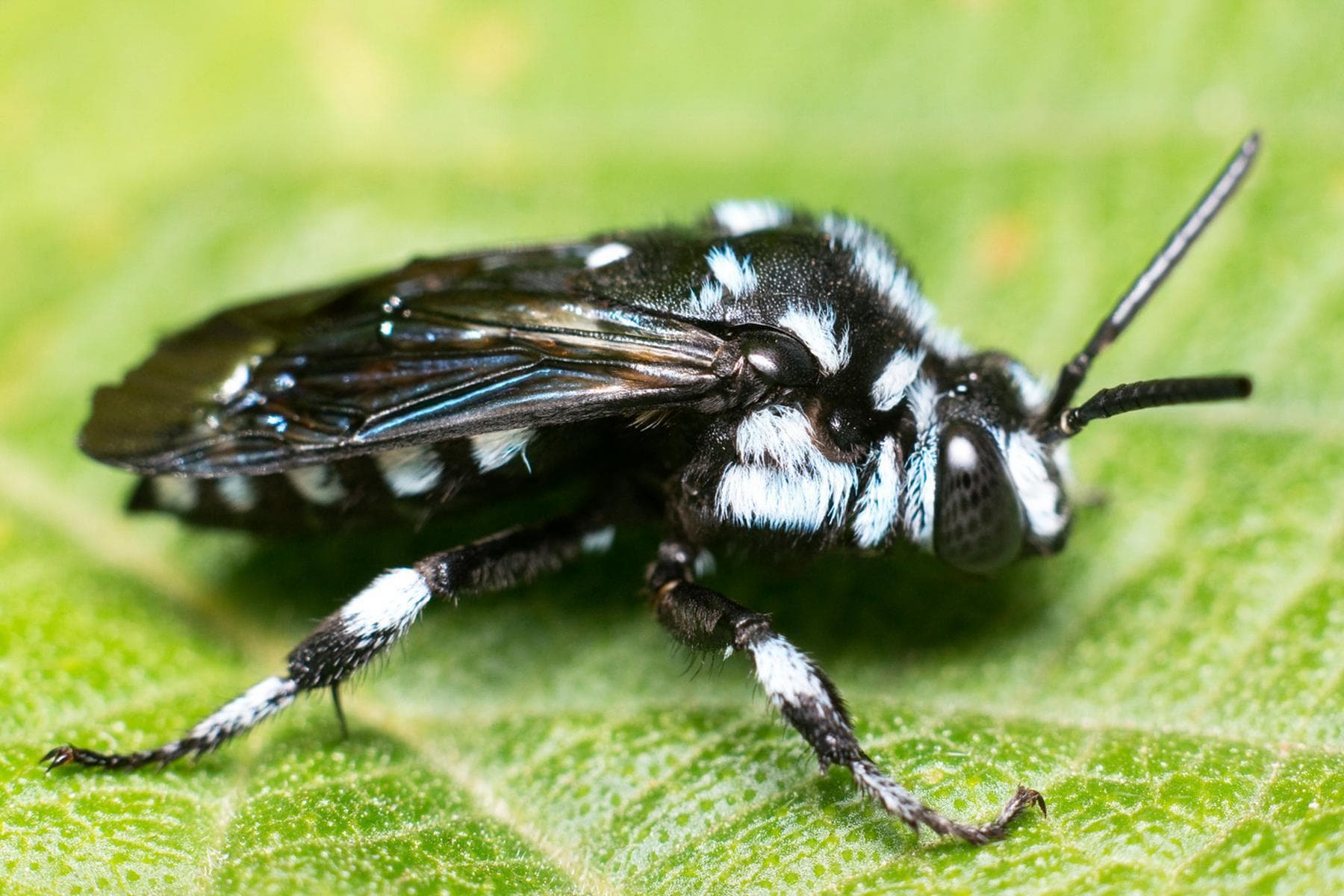
The bee in the photograph belongs to Thyreus, nicknamed 'domino cuckoo bees,' members of the family Apidae (the same family as honeybees and bumblebees) that never build a nest or collect pollen for their own young. Instead, they sneak into another bee's nursery and let that bee do all the work, exactly like the cuckoo bird they're named after.
What Do They Look Like?
Thyreus has a jet-black body with patches of dense white feather-like hairs on the face, thorax sides, and legs, plus white spots along the abdomen edges, and smoky or blue-tinted wings held flat against the body. Females lack pollen baskets on their legs entirely, since they never provision a nest of their own.
How Does the 'Cuckoo' Trick Work?
A female cuckoo bee waits until a host bee has provisioned and sealed a brood cell, then breaks in, lays her own egg on the stockpiled food, and in some cases her larva also destroys the host's egg or grub. The main hosts are digger bees in the genus Amegilla, with some Thyreus species specializing on Anthophora instead; confirming which cuckoo bee parasitizes which host requires watching an actual nest, not just seeing both flying near the same flowers.
Where Are They Found?
Thyreus is an Old World genus found across Africa, Europe, Asia, the Arabian Peninsula, and Australia, tracking its host Amegilla bees; researchers recognize roughly 108-115 species worldwide, about 50 of them in Africa. In Kenya, the host Amegilla vivida was only confirmed in 2019, and its documented parasite Thyreus pictus likely occurs there too, though a Kenyan specimen record hasn't yet turned up, despite one being catalogued just across the border in Ethiopia.
Why Do They Matter?
Cuckoo bees act as a natural population check on their host bees, similar to a hawk or wolf, since every successfully raised cuckoo bee generation means fewer host offspring survive. Because Thyreus depends entirely on its host doing well, it also serves as a biological indicator tied to the fortunes of pollinators that matter economically and ecologically, including the survival of a plant found nowhere else on Earth.
A Few Things Worth Knowing
Individual species carry names like the 'Neon Cuckoo Bee,' 'Chequered Cuckoo Bee,' and 'Domino Cuckoo Bee.' Many Thyreus species look nearly identical, and telling them apart often requires examining male genital structures under a microscope, with one paper calling the genus 'a bane of melittologists'; the shield-shaped plate on its thorax has also drawn research interest for studying how genes control body shape.
In Summary
The cuckoo bee survives entirely by breaking into another bee's sealed pantry rather than building its own, stripped of pollen-gathering tools but dressed in dazzling white-on-black colouring. Its fortunes rise and fall with the hardworking digger bees it depends on.