Click Beetle — The Insect That Flips Itself With a Snap
Coleoptera
What Are They?
Flip this beetle onto its back and it doesn't scramble around helplessly like most insects do. Instead, it goes still for a couple of seconds, arches its body like a bent bow — and then, with an audible click, launches itself into the air and lands back on its feet. That one trick gives the whole family its name: click beetles, in the scientific family Elateridae, a group so large it likely holds well over 10,000 species worldwide. They belong to the beetle order (Coleoptera), the single biggest group of animals on Earth, and within that they occupy their own strange niche: an elongated, hinged-body beetle that is essentially a tiny spring-loaded machine.
What Do They Look Like?
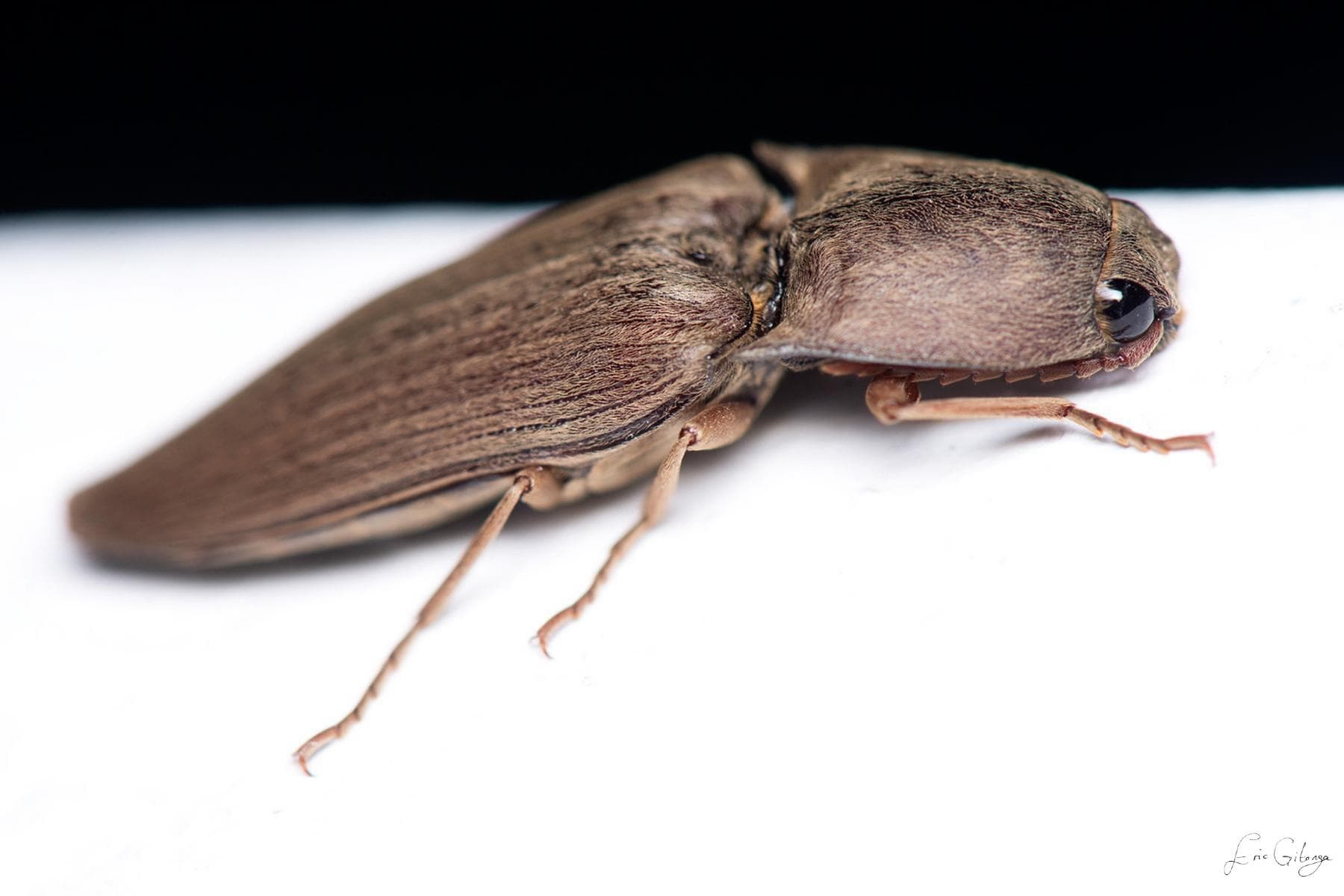
Adult click beetles are long, narrow, and fairly plain-looking at first glance — usually brown, black, or grey, and built for stealth rather than showing off. The giveaway is the join between the front section (behind the head) and the rest of the body: it's loosely hinged, not rigid like in most beetles, and the back corners of that front section stick out into two backward-pointing spikes. Their young, called wireworms, look nothing like the adults. They're thin, hard, shiny, wire-like grubs — brown or yellowish — that live underground and can take anywhere from two to eleven years to finish growing up, depending on the species. That's an extraordinarily long childhood for an insect.
How Does the "Click" Trick Actually Work?
This is the beetle's whole claim to fame, and scientists have taken it seriously enough to study it under microscopes with nanometer-level precision. Tucked into the beetle's underside is a small peg, and just ahead of it sits a matching ledge. When the beetle wants to right itself, it slowly bends its body until that peg locks into the ledge — like cocking a crossbow. Then it lets go. The stored energy releases in a fraction of a second, snapping the hinge straight, flinging the beetle upward, and producing the click you hear. Researchers who measured this in the lab found beetles ranging from about the size of a grain of rice to over an inch and a half long all using the same basic mechanism, just tuned differently — smaller species have shorter, stiffer pegs than larger ones. It's such an elegant, compact way of storing and releasing force that engineers building tiny robots have looked to it as a design model for miniature mechanical latches. Some click beetles take this even further: a handful of tropical species (mostly in Central and South America, plus a separate group recently discovered in Asia) glow continuously in the dark from spots on their body, unrelated to fireflies' on-off flashing. Oddly enough, genetic studies show fireflies are actually nested inside the click beetle family tree — meaning, biologically speaking, fireflies are essentially specialized click beetles that gave up clicking for glowing.
Where Are They Found?
Click beetles live almost everywhere on land, but their below-ground larvae in particular thrive in agricultural soil, grassland, and forest litter across the globe. Africa has its own rich, mostly homegrown cast: a dedicated survey of the continent south of the Sahara catalogued 945 species in 75 genera — a huge, largely underappreciated diversity. In Kenya specifically, confirmed sightings include a large fanged-antenna genus called Tetralobus around Amboseli and the Maasai Mara, an Alaus species (a predatory type, more on that below) near Watamu on the coast, and several other genera turning up in the Taita Hills, Wasini Island, and the Turkana region. Kenya actually has the best documented click-beetle records of any East African country in the international occurrence databases — though "best documented" here still means fewer than 1,500 confirmed sightings total, so there's almost certainly much more out there than has been recorded. One thing we couldn't find anywhere in the scientific literature: a local Swahili or other vernacular name for these beetles specifically — if one exists, it hasn't made it into print yet.
Why Do They Matter?
Most of the family's real-world importance happens underground, out of sight. Wireworm larvae are widely described as some of the most damaging soil pests on the planet, chewing through the roots, seeds, and tubers of crops like maize, potatoes, wheat, and sugarcane — sometimes for years before ever becoming an adult beetle. Because they live buried deep in soil and are so long-lived, they're notoriously hard to monitor and control, and farmers around the world have leaned on everything from crop rotation and tillage to fungal diseases, parasitic worms, and pheromone-baited traps to manage them. But it's not all bad news from this one family. Some genera, especially the large Alaus click beetles (nicknamed "eyed elaters" for the big fake eyespots on their backs), have larvae that are voracious predators of other pest beetles living in rotting wood — one study recorded a single larva eating over 200 wood-boring grubs before it finished growing. So within one family, you get both some of agriculture's worst underground pests and some of its quiet underground allies.
A Few Things Worth Knowing
Genetic testing has revealed that some wireworms considered a single species are actually several nearly identical "hidden" species that look the same to the naked eye but split apart from each other tens of thousands of years ago — a reminder that appearances can be deceiving even among insects scientists have studied for over a century. The eyespots on an Alaus click beetle's back are a bluff: bold black-and-white circles meant to startle a bird or lizard into thinking they're looking at the eyes of something much bigger and scarier. And that famous click? It isn't just for show — it's primarily a defense move. Startle a predator, right yourself, and get away, all in one motion that takes a fraction of a second.
In Summary
The click beetle's entire identity is built around one ingenious piece of body engineering: a spring-loaded hinge that turns "flipped onto your back" from a death sentence into a minor inconvenience. Above ground, the adults are unassuming background insects; below ground, their long-lived larvae quietly shape the fate of crops and forests alike — some as costly pests, others as unpaid pest controllers. It's a family that does most of its most important work where nobody's watching.