Carpenter Bee
Hymenoptera
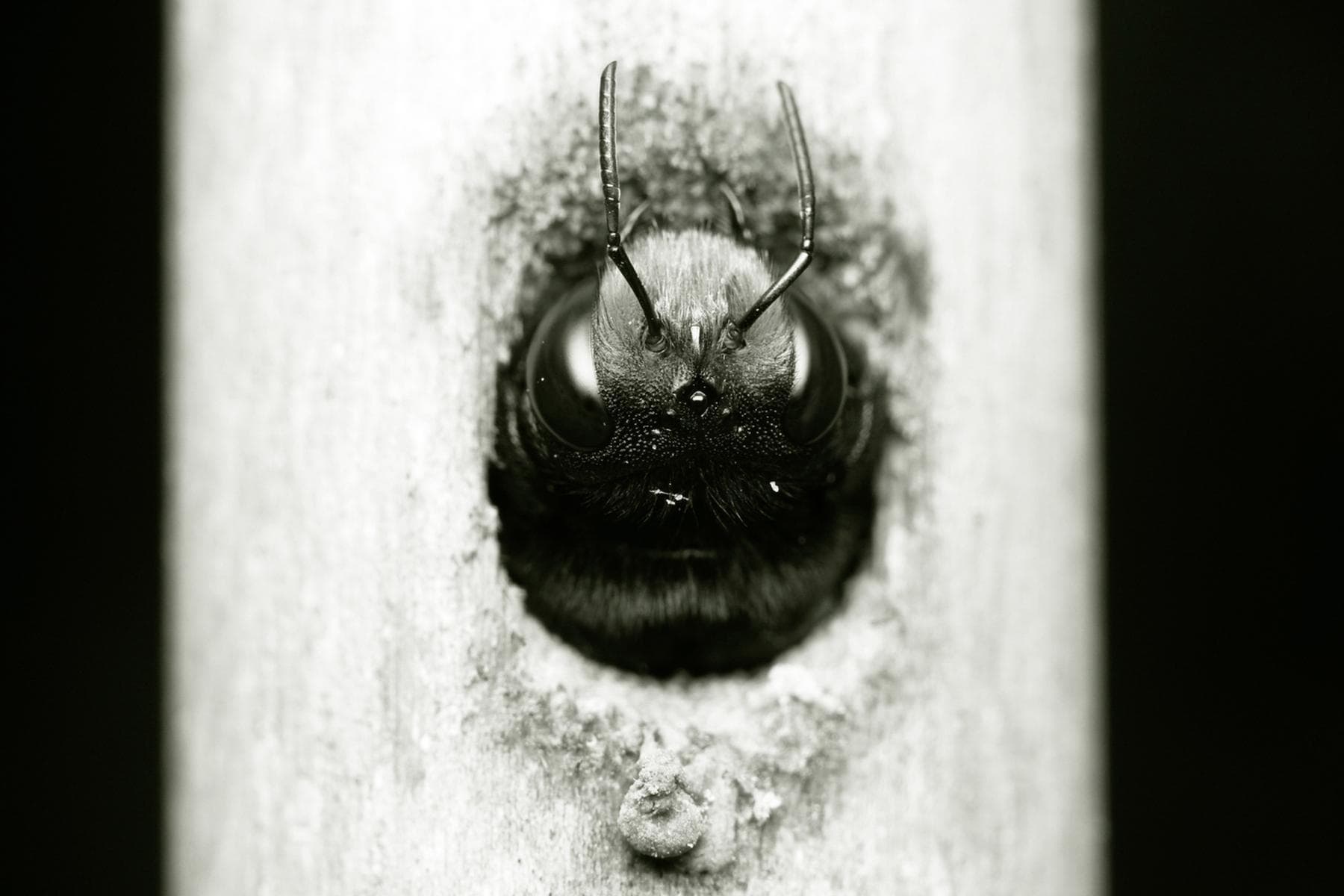
What Are They?
If you've ever seen a big, shiny black bee drilling a perfectly round hole into a fence post, a dead branch, or the eaves of a house, you've met a carpenter bee. They belong to the genus Xylocopa, and Kenya is home to a remarkable number of them — GBIF, the global biodiversity database, has logged over 800 sightings of carpenter bees across the country, spanning at least 15 different named species.
What Do They Look Like?
Carpenter bees are chunky and robust — noticeably bigger than most other bees you'll come across. People often mistake them for bumblebees, but there's one easy way to tell them apart: a bumblebee's abdomen is fuzzy all over, while a carpenter bee's abdomen is smooth, shiny, and almost hairless, like it's been polished. Males and females look slightly different too — males have a pale white or yellow patch on the face, while females' faces are solid dark.
How Do They Build Their Homes?
This is where the name comes from. A female carpenter bee doesn't build a nest from scratch out of wax like a honeybee — she chews her way into solid wood, using her powerful jaws to carve out a tunnel. In one well-studied relative, females dug tunnels as deep as 40 centimetres for overwintering, and built branching networks of cells for raising young — each one stocked with a ball of pollen and nectar before being sealed shut with chewed wood pulp, like a tiny larder for the next generation. Interestingly, carpenter bees aren't quite "loners" the way people often assume. It's common for a nest to be shared by a mother and one of her daughters — one bee stays inside doing guard duty, keeping intruders out and the nest clean, while the other flies out to gather food and lay eggs. Sometimes, remarkably, the daughter can even take over the egg-laying role from her own mother.
Why Do They Matter?
Carpenter bees have a superpower most bees don't: they can "buzz" pollen loose. Some flowers — tomatoes are a great example — keep their pollen locked inside tiny pores instead of leaving it out in the open. A honeybee simply can't get at it. A carpenter bee, though, grips the flower and vibrates its flight muscles so hard the pollen shakes free, like a tiny tuning fork. In studies done in Kakamega, western Kenya, this "buzz pollination" from carpenter bees produced noticeably better tomato fruit than honeybees managed — the honeybees, in fact, were caught tearing at the flowers and damaging them just to steal pollen they couldn't otherwise reach. Carpenter bees also turn out to matter a lot to French bean farming near Mount Kenya, one of the country's major smallholder export crops — a study there found that farms closer to the forest, with more carpenter bees around, produced noticeably better bean yields than farms farther away with fewer bees.
Any Surprising Facts?
Not every carpenter bee plays fair. Some species have worked out a shortcut: instead of pushing into a flower the "front door" way and picking up pollen along the way, they slice a little slit straight into the base of the flower with their jaws and drink the nectar directly — no pollination service rendered. And once a carpenter bee has cut that opening, other bees, including honeybees, sometimes sneak in through the same hole afterward. One more thing worth knowing: the same tunnel a carpenter bee digs into a piece of wood doesn't get used just once. Bees can return to it and extend it year after year, generation after generation — some documented tunnels have stretched to nearly 60 centimetres long after years of reuse.