Assassin Bug
Reduviidae · Hemiptera
What Are They?
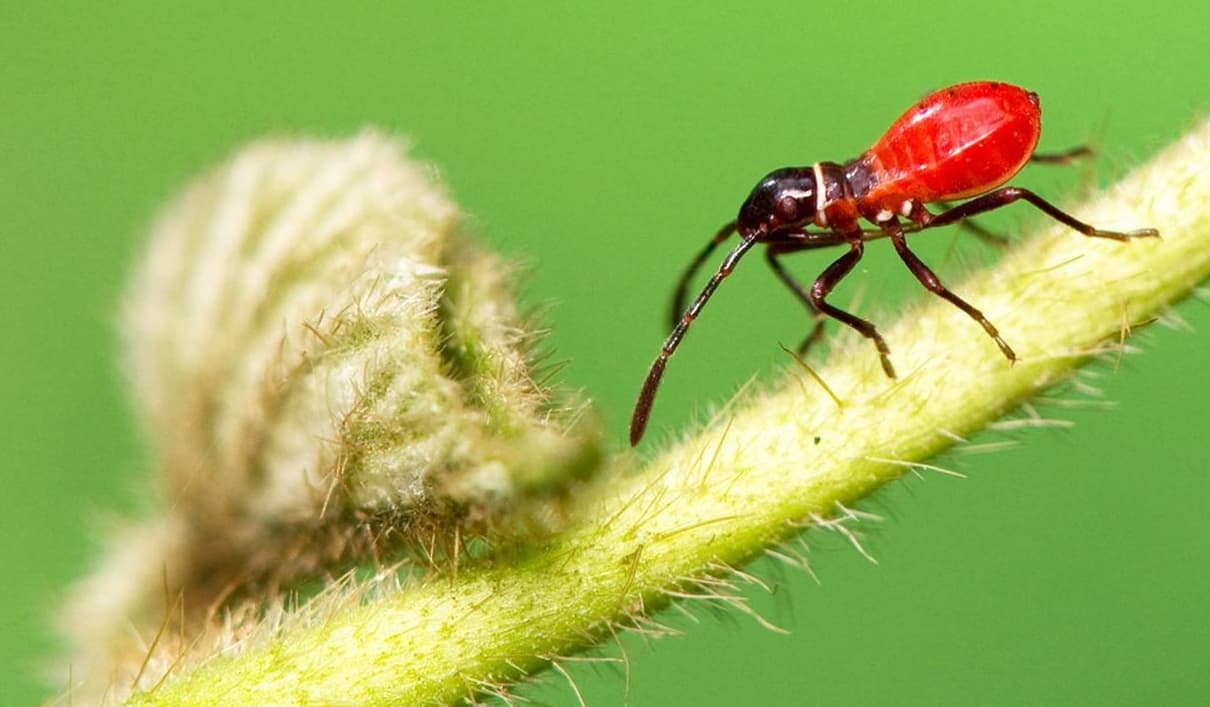
Assassin bugs are an entire family, Reduviidae, with 6,800-7,000 known species that stab prey with a needle-like beak, inject a liquefying cocktail, and drink the results. The photographed nymph, with its bright red body and black head and legs, belongs to the family's largest branch, Harpactorinae (about 2,000 species), but nymphs cannot be pinned to an exact species from a photo alone.
What Do They Look Like?
The family's giveaway is a ridged sound-producing groove on the underside of the chest, a long narrow 'neck,' and a curved needle-like beak folded beneath the head; sizes range from 4 cm giants to 2-3 mm specks, with most adults drab but many nymphs bold red-and-black. They hatch as wingless miniature adults and pass through about five nymph stages before their final molt into a winged adult.
How Does It Hunt?
Most assassin bugs are ambush predators that grab prey with their front legs and drive in a needle-beak, injecting enzyme-laden saliva that dissolves the victim's insides before drinking the liquefied meal. One African species disguises its nymphs with a 'backpack' of up to 20 dead ant carcasses, proven at Lake Victoria to fool sight-hunting jumping spiders, while two other species studied near Mbita Point specialise in hunting jumping spiders themselves.
Why Should You Be Careful?
The needle-beak can pierce human skin and, by documented account, causes sharp immediate pain and swelling; one case report describes itching lasting two weeks with full recovery within three weeks. A related subfamily, Triatominae or 'kissing bugs,' feeds on blood and spreads Chagas disease in the Americas, but a 2025 global survey found essentially no established populations anywhere in East Africa, and the pictured ambush-predator nymph is not one of them.
Why Do They Matter?
Assassin bugs are valuable to farmers; in West Africa two species were observed preying on fall armyworm caterpillars, a serious maize pest across the region including Kenya, and in Benin another species measurably reduced damage to stored yam chips. Researchers in India mass-rear an assassin bug species for release onto cotton fields as pest control, and while there is no documented Kenya-specific release programme yet, Kenya hosts nearly 500 recorded assassin bug sightings, several from a genus already proven useful as biocontrol elsewhere.
A Few Things Worth Knowing
The 'horrid king assassin bug' produces venom combining prey-killing, antimicrobial, and tissue-breaking functions, and a related species secretes venom from three separate glandular chambers each with a specialised job. Assassin bugs also make sound using the ridged chest groove and beak tip, though exactly what the sound is used for in the wild remains an open question.
In Summary
The assassin bug family combines patient ambush hunting with a chemical weapon disguised as a drinking straw, including at least two Kenyan species that hunt spiders instead of insects. The red-and-black nymph photographed belongs to the family's largest branch and is likely already stalking its next meal.