Armoured Weevil
Coleoptera
What Are They?
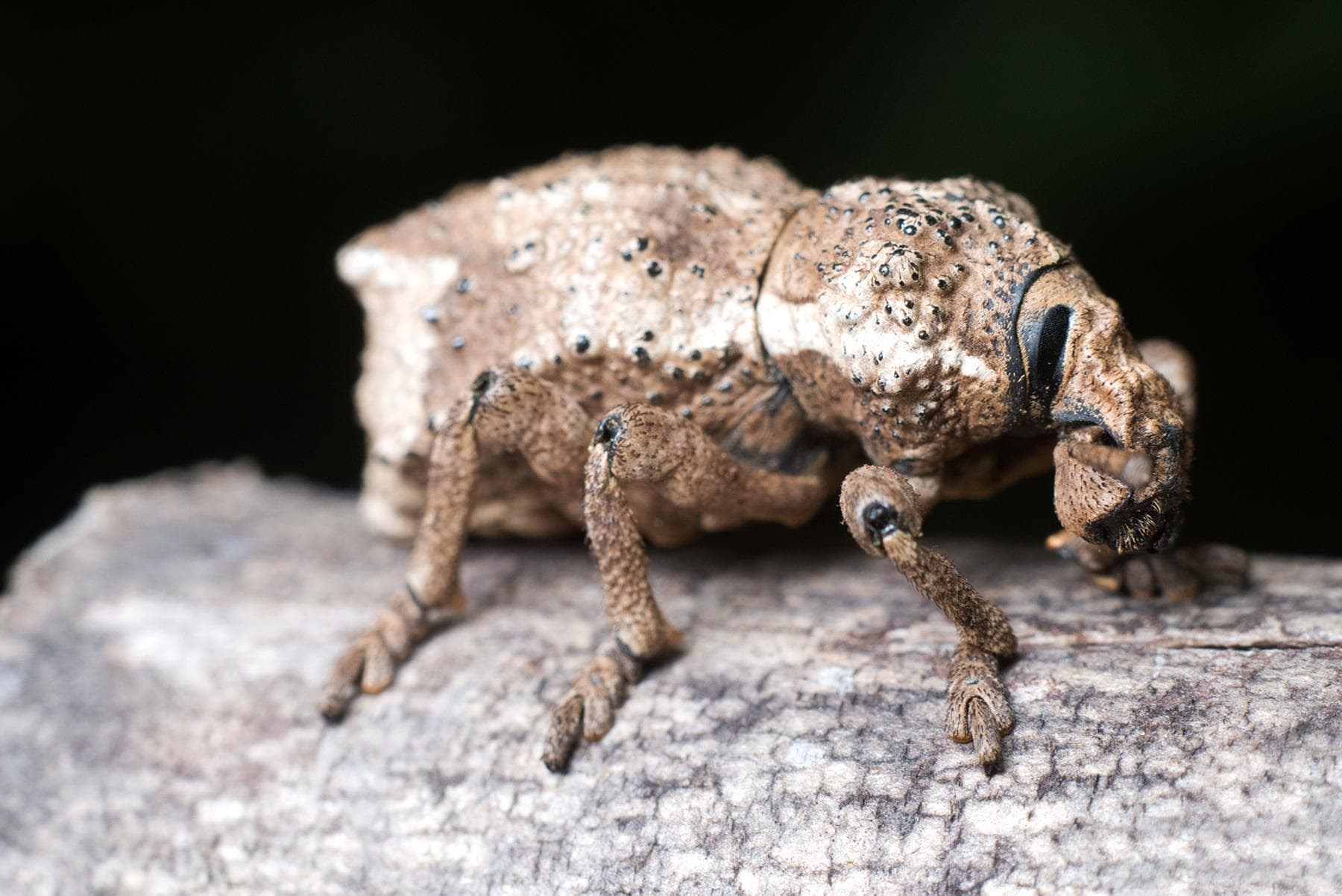
Meet the armoured weevil — a beetle that looks like it's wearing a suit of ancient, pitted armour plating. It belongs to the genus Brachycerus, part of the weevil family, and it's built completely differently from the beetles most people picture: it can't fly at all. Its wing covers are fused shut into one solid, rugged shell, permanently welded together like a tank hatch that's rusted closed.
What Do They Look Like?
Its whole body is covered in deep pits, warty bumps, and rough furrows — no smooth, shiny beetle shell here. Instead of the sleek curve most beetles have, this one looks almost hand-carved from bark or stone. Out front is a long, thick, downward-curving snout, and its legs are stout and clawed, built for gripping and digging rather than speed. Some species even have a knife-like edge on their front legs. It's a heavyweight among weevils — solidly built, in browns and creams that blend perfectly into dry wood and soil.
How Do They Live?
The young (larvae) grow up inside the bulbs of wild lily-family plants — things like Crinum, Clivia, and a famous plant called Boophone disticha. The larva burrows into a bulb and feeds from the inside out, using the bulb as both food and shelter until it's ready to emerge as an adult. Beyond that early bulb-feeding stage, though, surprisingly little has actually been documented about how these weevils go through the rest of their life — nobody's published good detail yet on the egg stage, how long they live as adults, or exactly how they reproduce.
Where Do They Live?
Armoured weevils are an African speciality — around 300 species live mostly in sub-Saharan Africa, with a much smaller cousin population up in North Africa and the Mediterranean. Kenya has confirmed sightings from several very different corners of the country: the dry Kajiado and Laikipia rangelands, the Dakatcha coastal woodlands near Kilifi, the Rift Valley near Nakuru, and Kakamega in the west — meaning this isn't a one-habitat specialist, it turns up across a real spread of Kenyan landscapes. Oddly, the very best place in Africa to find lots of different armoured weevil species isn't the lushest, most plant-rich region — it's the dry, comparatively plain Nama Karoo of southern Africa. Scientists have found more of these flightless weevils there than in famously plant-diverse hotspots like the Cape Floristic Region, which is a genuinely surprising twist: sometimes the toughest, driest places produce the richest weevil diversity, not the greenest ones.
Why Do They Matter?
A few of this weevil's relatives are considered pest species elsewhere — onion and garlic weevils that trouble crops in parts of the Mediterranean and Middle East. But when scientists recently surveyed the actual soil pests troubling onion and cabbage farms in Kenya, armoured weevils didn't show up on the list at all — so despite the family name, there's no evidence they're currently a farming problem here. Instead, their real significance in this part of the world seems to be cultural: one species and its host bulb plant show up again and again in southern African traditional healing practices, an association that has apparently lasted across generations and several different communities.
Fun Facts
• These weevils are so heavily armoured and settled into ground life that they've simply given up flying altogether — their wing covers are fused into one solid, immovable shell. • Even scientific databases haven't fully sorted out where this genus belongs — some records file it under one weevil family, others under a different one, an inconsistency that's still unresolved today rather than settled history. • The wider weevil family this beetle belongs to is enormous — an estimated 220,000 species may exist worldwide, of which around 62,000 have actually been described and named so far. • Unlike most weevils, whose antennae have a sharp "elbow" bend, this genus's antennae are short and straight — a quiet reminder that even a very weevil-looking beetle can break the usual rules.