Aedes Mosquitoes
Diptera
What Are They?
Meet the mosquito that outsmarts drought. Aedes is a huge group of mosquitoes — nearly a thousand species strong, found on every continent except Antarctica — and it includes two of the most infamous insects on the planet: Aedes aegypti, the yellow fever mosquito, and Aedes albopictus, the Asian tiger mosquito. Between them, these two species are responsible for spreading dengue, Zika, chikungunya, and yellow fever to hundreds of millions of people every year. Here's the twist: scientists studying their family tree recently discovered that "Aedes" isn't really one clean, unified genus at all. Genetically, the roughly 932 species lumped under that name don't all share one common ancestor to the exclusion of everything else — it's a bit like discovering that a "family" you thought was one bloodline is actually several different families that got mixed up in the paperwork. Untangling it properly is still ongoing work.
What Do They Look Like?
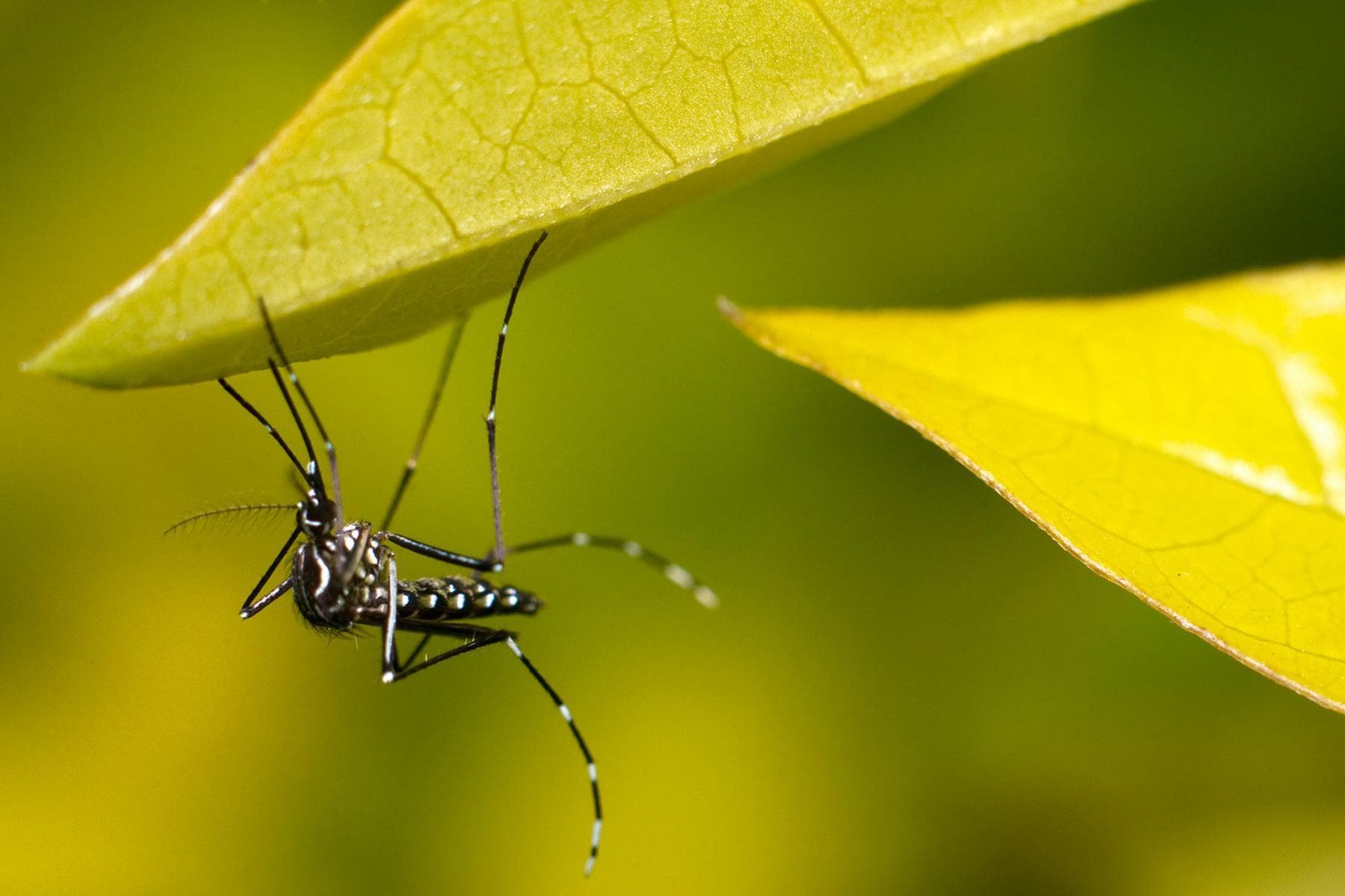
• Signature style: Narrow, dark bodies decorated with sharp black-and-white or silver scale patterns on the back and legs — think of them as the zebra-striped mosquitoes, especially Ae. albopictus, whose "tiger" nickname comes straight from those stripes. • A body that stretches with the weather: Remarkably, the mosquitoes' own wing length changes depending on how warm it was while they were growing up — cooler nurseries produce noticeably bigger-winged adults. In lab tests, wings grown at a cool 15°C (59°F) were around 30% longer than wings grown at a hot 35°F (95°F). • Not one species, but two disguised as one: Yellow fever mosquitoes come in a pale, city-loving form and a darker, wild form, and a genetic study in Senegal found the two forms interbreed and mix so freely — over 40% of family groups contained both — that scientists now think of it as one flexible, shape-shifting species rather than two separate ones.
How Do They Feed and Breed?
Female Aedes mosquitoes need blood to make eggs, and they're expert opportunists about where they lay them: rather than ponds or lakes, they favor tiny puddles of water sitting in man-made containers — buckets, flowerpots, gutters, and, overwhelmingly, old discarded tires. In one large survey across Cameroon, old tires alone accounted for over 85% of every spot where mosquito larvae were actually found — dwarfing every natural water source combined. It turns out a mosquito nursery is often hiding in a junkyard, not a wetland. Their feeding and breeding habits shift with the thermometer too: Ae. aegypti bites most eagerly and lays the most eggs around 30°C (86°F), while the cooler-climate Ae. albopictus peaks a bit lower, around 25°C (77°F) — a small but telling difference that traces back to their different evolutionary homelands.
Growing Up — From Egg to Adult
Like all mosquitoes, Aedes passes through four life stages — egg, larva, pupa, adult — with the first three spent in or near water and only the adult taking to the air. Under good conditions, the whole journey from egg to flying adult takes as little as 7 to 10 days. But the real party trick happens right at the very start. A freshly laid Aedes egg is fragile and will shrivel up if it dries out — for about the first half-day of its existence. Then, in a narrow two-hour window roughly 11 to 13 hours after being laid, the embryo suddenly builds itself a tough, chitin-armored raincoat called a serosal cuticle. Flip the switch before that window and the egg dies in dry air; flip it after, and that same egg can sit bone-dry for months and still hatch perfectly fine once it gets wet again. This is exactly why Aedes mosquitoes thrive around temporary puddles that come and go with the rain — their eggs are built to simply wait out the dry spells.
Where Are They Found?
Aedes mosquitoes have colonized virtually the entire planet, missing only Antarctica. But within that huge range, the two star species behave quite differently. In a detailed survey of Cameroon, the yellow fever mosquito was found absolutely everywhere researchers looked, while the Asian tiger mosquito was confined to the wetter south, stopping short at an invisible climate boundary further north. Genetic fingerprinting of the tiger mosquitoes there told an even more striking story: nearly 80% of all individuals sampled carried the exact same genetic signature — the kind of pattern you'd expect if the entire population sprang from just a handful of founding mosquitoes that arrived relatively recently and then spread like wildfire.
Why Do They Matter?
This is where the story turns serious. Aedes aegypti is the world's primary carrier of dengue fever, and the numbers are staggering: reported global cases climbed from about half a million in the year 2000 to a record 14.6 million in 2024 — nearly a thirty-fold jump in under 25 years — and that's likely an undercount, since many affected countries struggle to track and report every case. Zika, chikungunya, and yellow fever ride on the same mosquitoes' backs. A single infected mosquito stays infectious for the rest of its life once it picks up a virus, and it can pick that virus up from a person days before that person even feels sick.
A Few Things Worth Knowing
• Their family tree is a mess — on purpose, sort of: To sort out how all these mosquito species relate to each other, one research team scored 172 different physical features across every single life stage — egg, larva, pupa, and adults of both sexes — of 119 different species. That level of detail is almost unheard of in insect taxonomy, and it's what led scientists to split Aedes aegypti and Aedes albopictus off into their own genus, Stegomyia, for a while (though many researchers still just call them Aedes out of habit and convenience). • A two-hour biological switch flips their entire survival strategy: Before hour 11, a mosquito egg is basically a water balloon. After hour 13, it's a tiny drought-proof capsule. Nothing else about the egg changes much — just that one armor-plated raincoat. • Old tires are secretly ecological hotspots — for all the wrong reasons: A pile of abandoned tires in the rain isn't just an eyesore; it may be one of the most productive mosquito nurseries in the entire landscape.
In Summary
Aedes mosquitoes are a sprawling, still-being-sorted-out group whose two most famous members — the yellow fever mosquito and the Asian tiger mosquito — have turned old tires and rain puddles into launch pads for some of the world's fastest-growing infectious diseases. Their eggs' astonishing drought-proofing trick, and their knack for exploiting whatever man-made puddle happens to be lying around, are exactly what makes them such formidable, adaptable survivors — and such a persistent public health challenge.